
An introduction to the framework and structure
Part of a toolkit for the ethical and effective use of children's information. Select the quick links below to explore the key sections of this page.
About the toolkit
The toolkit for ethical and effective use of children's information was developed by the Children’s Information Project. Designed to transform how information about and from children and families is used to support them. Its main purpose is to bridge the gap between data and human-centred care.
The toolkit shows that ethics and effectiveness go hand in hand. True effectiveness—meeting needs, achieving positive outcomes, and fulfilling duties—cannot happen without ethical practices like transparency, equity, and respect for rights. By prioritising ethics, the toolkit builds the relational trust needed for good outcomes.
How it helps local authorities:
- Look beyond process and compliance measures.
- Supports teams in developing a comprehensive voice-informed picture of children's needs, trajectories, and real-world outcomes.
- Provides four core approaches, eight practices, and system enablers to help translate values into daily practice.
- Provides practical tools to help improve information systems.
How it helps children and families ensure:
- The diverse voices of children, young people, parents, and carers are heard clearly within information systems.
- Diverse voices actively shape how information is gathered, shared, and acted upon.
- Lived experiences do not get lost in bureaucracy. Voice is valued as much as data.
- Lived experience shapes and improves services.
Overview of the framework
The framework is organised around three structural layers:
- Core approaches define WHAT we want to achieve and WHY. They cover strategic goals and mindsets.
- Practices define HOW you do it. For example, operational methods and workflows.
- System enablers are the CONDITIONS that help improve information use.
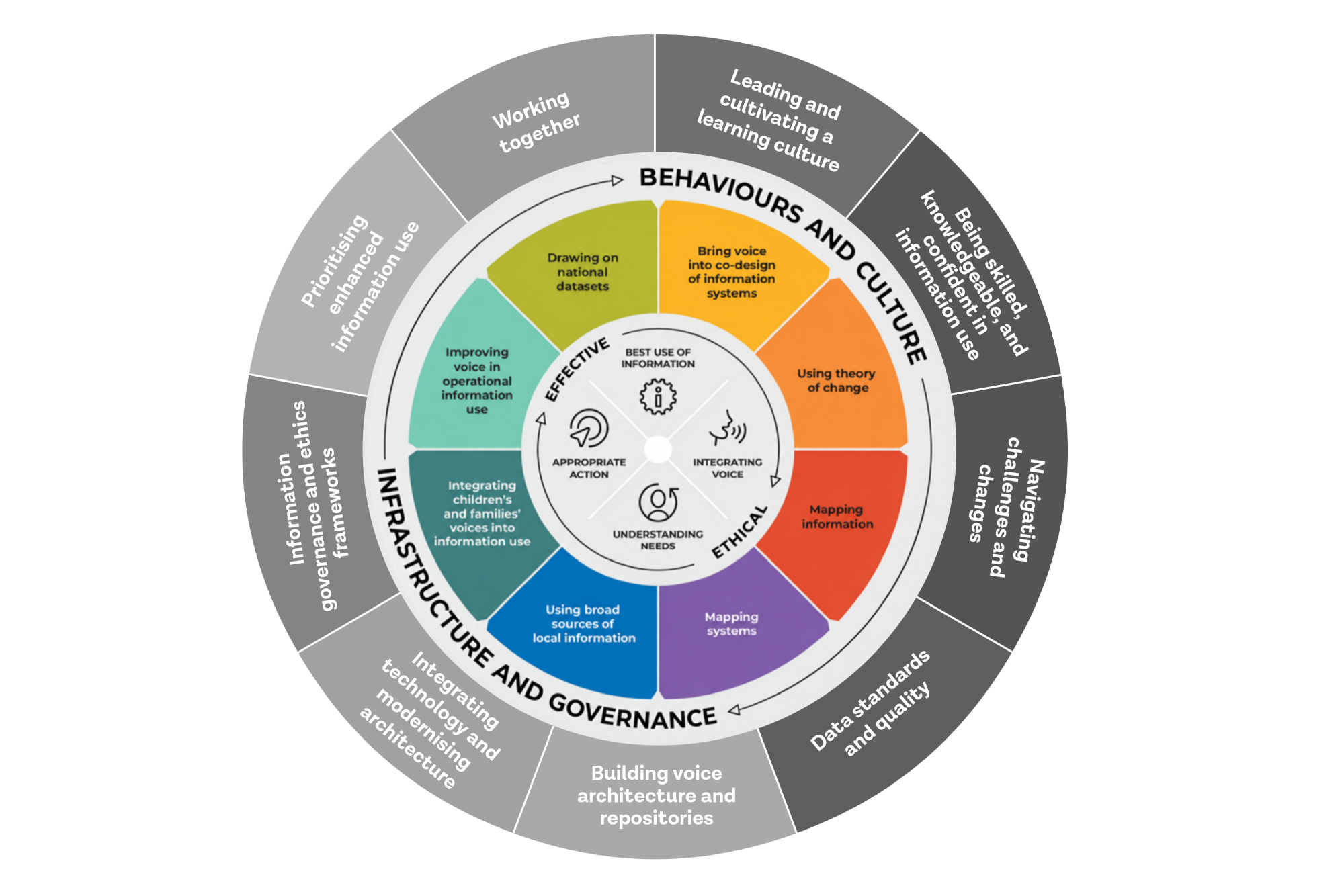
Three structural layers of the framework.
Core approaches
The framework outlines four core approaches. They intersect, but each is unique and vital for ethical and effective information use. Below is a brief outline of each core approach.
Voice is not straightforward. It may be expressed or silenced in different ways, and it is shaped by relationships of power. Right now, national and local datasets show government priorities. They don't reflect the real experiences of children and families.
Listening to children, families, and practitioners is key for ethical and effective information use. For these voices to matter, they must be included at all levels. This includes daily individual support and wide-ranging population planning. Information systems should capture real experiences. This information should be accessible, meaningful, and easy to analyse and act on.
What this looks like in practice
-
Accessible ways to invite, hear and respond to the views, wishes and feelings of children, families and practitioners.
-
Supporting understanding about what information is gathered and why.
-
Respecting children's and families’ right to have a say in what happens to their own information.
-
Embedding this rights-respecting practice into everyday work with individual children and families.
-
Ensuring diverse voices inform strategic policy and planning.
The Children's Information Project reviewed children's needs and outcomes frameworks. This helped understand key elements for improving outcomes. This review found eight priorities:
-
Focus on children's lives and experiences. Consider their chances for wellbeing in different areas, not just one.
-
Understand needs and pathways to support and care. Show how these needs change over time. Also, consider how children engage with different services.
-
Take account of context, including household circumstances and place-based needs.
-
Gather the thoughts, feelings, and priorities of children and young people to amplify their voice. Also, consider the views of those who represent their interests.
-
Address data exclusion by properly representing disadvantaged and seldom-heard groups.
-
Draw on qualitative as well as quantitative information.
-
Avoid over-centralisation, making full use of local knowledge and understanding.
-
Empower children and young people to influence decisions, policy and practice. Adopt meaningful co-production strategies that share power. Avoid tokenistic and repetitive consultation.
Making best use of available information means expanding beyond narrow compliance metrics to capture what matters most to children and families. Local authorities achieve this by pairing statutory service measures with holistic insights. For example, evaluating a care leaver's accommodation based on proximity to friends, education, and jobs, rather than simple metrics.
In practice this means:
-
Aligning statutory obligations with local priorities. Fulfil mandatory national returns while designing local outcomes that reflect community needs and practice values.
-
Developing systems that pull rich, narrative insights from case records into aggregate reports to inform policy and commissioning.
-
Connecting information flows across health, education, and social care to build a complete, shared picture of a child’s real-world circumstances.
This approach ensures rich and diverse information sources shape decisions and improve outcomes.
Appropriate action and learning are the ultimate goals of ethical and effective information use. This closes the loop between information gathering and practice improvement. To ensure information actively shapes decisions, organisations should establish clear pathways from insight to action:
-
Linking daily data practices to long-term outcomes. This ensures system improvements remain purposeful, ethical, and aligned across multi-agency teams. A Theory of Change (ToC) can help.
-
Cultivate a learning culture. Using information to guide decision-making replaces defensive compliance with curiosity. It helps a diverse network of practitioners and leaders focus on a shared vision.
-
Create a clear path from collecting information to using it.
-
Driving lasting improvement requires a strong commitment from leaders to work together and prioritise ethical and effective information use.
The four approaches are supported by the eight information use practices, an overview of these practices follows below.
Eight information use practices
The Framework includes eight information use practices and these bring the core approaches to life.
Four of the practices are foundational. These are the main steps to prepare to use information ethically and effectively:
- Bringing voice into co-design of information use.
- Using theory of change.
- Mapping information.
- Mapping systems.
The final four practices show how to improve information use for better decision-making:
- Using broad sources of local information.
- Integrating children's and families' voices into aggregate and strategic information.
- Improving voice in operational information use.
- Drawing on national datasets.
All practices work together to support ongoing learning and lasting improvement. Local authorities might use different practices at different times. They might also combine these practices in various ways for different information uses. A clear set of practices helps define and map what is needed for ethical and effective information use.
Systems enablers
System enablers create the necessary conditions for ethical and effective information use. The approaches and practices rely on enablers to work properly. The two system enablers are:
- Behaviour and culture.
- Infrastructure and governance.
Enablers help the system function well and are often invisible unless they are broken. System barriers are often noticeable because they slow things down and create friction.
System enablers work together to create the conditions for ethical and effective information use. They include the human elements and scaffolding that are necessary to achieve a shared vision. Focusing on the approaches and practices without attending to enablers and barriers, creates a vision that is difficult to achieve and sustain.
The enablers included in the framework are a guide - not a fixed list. System enablers are contextual and will evolve.
Behaviour and culture
Behaviour and culture explore the 'soft' human elements. This includes mindsets, leadership styles, skills, and shared norms.
It also includes the shared values, norms, attitudes, and practices within local systems. They shape how people see, value, and use information. These elements shape how the infrastructure is used in real life.
Behaviour and culture can be considered across five domains:
-
Prioritising enhanced information use.
-
Working together.
-
Leading and cultivating a learning culture.
-
Being skilled, knowledgeable, and confident in information use.
-
Navigating challenges and changes.
Infrastructure and governance
The 'hard' scaffolding. Infrastructure and governance include technology, standards, and ethical guidelines.
-
Infrastructure includes data architecture, standards, platforms, and tools used to collect, store, share, and analyse information.
-
Governance covers the rules, agreements, and ethical frameworks. They define roles and responsibilities and ensure information is kept safe, high-quality, and compliant.
Infrastructure and governance can be considered across four domains:
- Data standards and quality.
- Building voice architecture and repositories.
- Integrating technology and modernising architecture.
- Information governance and ethics frameworks.
Ethical and effective information use in practice
A collection of practice examples and tools accompanies the framework. They have been curated to show how local authorities:
-
Bridge the gap between high-level data frameworks and frontline children's services.
-
Use the core principles, eight information use practices, and system enablers in real-world scenarios.
-
Improve local information use and systems with a view to improving outcomes.
The toolkit includes resources from the Children’s Information Project, Research in Practice, local authorities, and other expert organisations.
A toolkit for the ethical and effective use of children's information
Digital resources explore definitions, tools and examples for practitioners and data leads to strengthen children's information use.

Children's Information Project
An innovative and collaborative project to improve the way that information about and from children, young people and families is used in local and national Government.